Tegucigalpa, Honduras — 9:15 AM CST
Bricks to Bytes: Laying the Groundwork for Tokenized Real Estate Asset Management
With commercial real estate tokenization projected to expand sharply over the next decade, asset managers and investors in Honduras—especially those building portfolios in Tegucigalpa—have new tools to consider, along with new risks to manage.
By One West Realty (Tegucigalpa Market Desk)
Key takeaways
- Tokenization could reshape commercial real estate by improving settlement efficiency, enabling fractional ownership, and opening new investment structures.
- Risk management matters: regulatory compliance, custody, taxation/accounting, and cybersecurity should be addressed before moving capital on-chain.
- Fund structures are a leading use case, with two primary approaches: tokenizing off-chain vehicles or issuing new on-chain agreements (where legally viable).
Why this matters for Tegucigalpa investors
Tegucigalpa’s real estate market attracts a mix of local buyers, diaspora capital, and long-term investors seeking rental yield and capital preservation. Tokenization—done responsibly—can expand access to real estate exposure (including partial ownership), streamline recordkeeping, and improve liquidity options compared to traditional, paper-heavy processes.
But “more accessible” doesn’t mean “less risky.” In practice, tokenization introduces technology risk (platforms, smart contracts), counterparty risk (issuers, custodians), and legal enforceability questions (what happens off-chain when something goes wrong?).
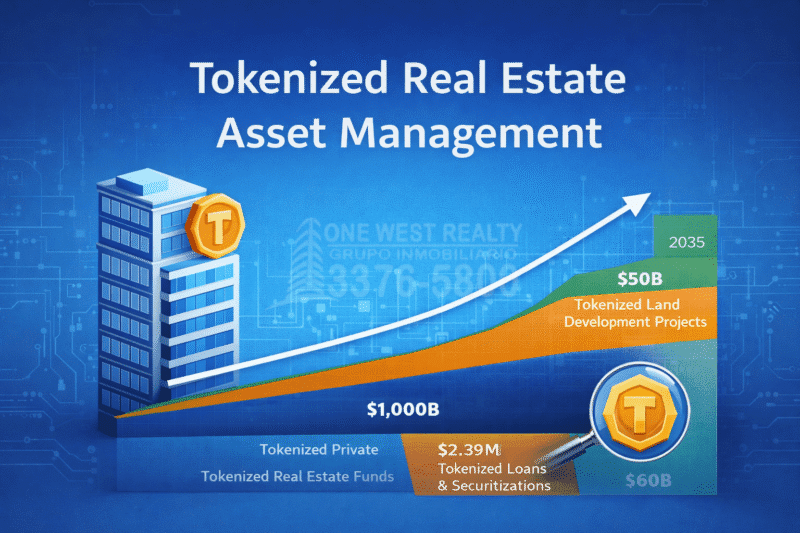
Trendline: tokenized real estate (2025–2035)
The chart below follows an illustrative growth path using the widely cited 27% CAGR forecast toward a ~$4T tokenized real estate market by 2035.
Note: This chart interpolates yearly values using a constant CAGR to show the trend from 2025–2035; real-world adoption may be uneven by region and asset type.
What to consider before entering the market
1) Not all blockchains are created equal
Some networks prioritize speed and security (often at a higher operating cost), while cheaper networks may struggle with scalability or proven security. Before selecting a platform, real estate firms should evaluate: regulatory compliance, confidentiality, data integrity, and the availability of reliable asset servicing and distribution capabilities.
2) Custody of tokenized assets is unique
Self-custody is possible, but most enterprises prefer trusted third parties. Fintechs and banks may offer digital-asset custody, but this is still a relatively new market that demands deep blockchain engineering expertise. Seek specialist advice when selecting custody and operational controls.
3) Taxation and accounting may differ
Digital tokens can have unexpected tax and accounting characteristics versus non-tokenized equivalents. Plan ahead to avoid surprises in reporting, valuation, and cross-border compliance—especially relevant for Honduran investors with U.S. ties.
4) Tokenization can add liquidity and flexibility
Investors can participate through direct equity, partial ownership, or commingled vehicles. Tokenization can broaden these options and potentially improve transferability—depending on the platform rules, investor eligibility, and local legal enforceability.
5) Security benefits have limits
Tokenization can reduce exposure of sensitive data, but it is not a complete cybersecurity solution. Firms should harden infrastructure against breaches (segmented environments, secure key management, incident response), and avoid treating tokenization as a silver bullet.
Two ways to tokenize real estate funds
Funds are a practical on-ramp because they already have defined governance, reporting, and investor eligibility processes. Tokenization can streamline issuance, servicing, and secondary transfers—reducing intermediaries when done correctly.
Approach A: Tokenizing an “off-chain” fund (or using a decentralized lending protocol)
An originator pools loans and sells them to a special-purpose vehicle (SPV). The SPV issues debt tokens backed by the loans, allowing investors to hold tokens or use them as collateral in secondary markets (where permitted).
Approach B: Issuing new funds “on-chain”
New vehicles can be issued on-chain based on agreements between borrowers and lenders, sometimes structured as real estate trust deeds with covenants that allow property to be held in a neutral, third-party trust until the debt is satisfied—subject to jurisdictional feasibility.
2035 ecosystem: where the value may concentrate
Forecasts suggest a meaningful share of tokenized real estate value could accrue to loan and securitization tokens, followed by private real estate funds—with additional growth across other segments.
The “Other segments” bar represents the difference between the total forecast and the listed major components.
Operational reality check: default, enforcement, and “real-world” control
Investors should understand what happens if a fund or issuer defaults. Can a lender or trustee take control of the actual underlying asset—not just the digital token? Early movers should run legal and operational “fire drills”: lien perfection, trustee powers, dispute resolution, and cross-border enforceability.
Done correctly, embedding coded rules in tokens and linking them to enforceable off-chain agreements can support automatic compliance, capital calls, and distributions—potentially improving the end-to-end workflow of fund administration.
Rethinking securitized loans and home equity
While securitized products carry historical baggage, blockchain asset-backed structures are attracting interest. Some investors see value in near real-time reporting, improved traceability, and operational savings across origination, aggregation, and servicing—if governance and disclosure are strong.
Undeveloped land and new construction
Beyond fractional ownership of existing buildings, tokenization may support infrastructure and under-construction projects. Financing needs change over the project life cycle; tokenization can enable capital formation across the stack (debt, equity, hybrids) on a single platform—subject to local legal constraints.
One West Realty perspective: practical next steps
- Start with a small pilot (one asset or one fund sleeve) and document governance, KYC/AML, and disclosure.
- Select infrastructure intentionally: chain choice, smart-contract audits, custody model, and reporting cadence.
- Stress-test downside scenarios: default, key compromise, platform failure, legal disputes, and investor redemptions.
- Align with your investment thesis: yield focus, sustainability overlays, location preferences, and exit timing.
Related reading and resources
- Inbound (One West Realty): Get a good a good return on your investment, but a condo at Igvanas Tara
- Outbound (market context): Midwest housing affordability trends
Bottom line: Tokenization could unlock new efficiencies and broader participation in real estate, but the winners will be the firms that treat it as a regulated financial product—prioritizing enforceability, custody, cybersecurity, and transparent investor protections.